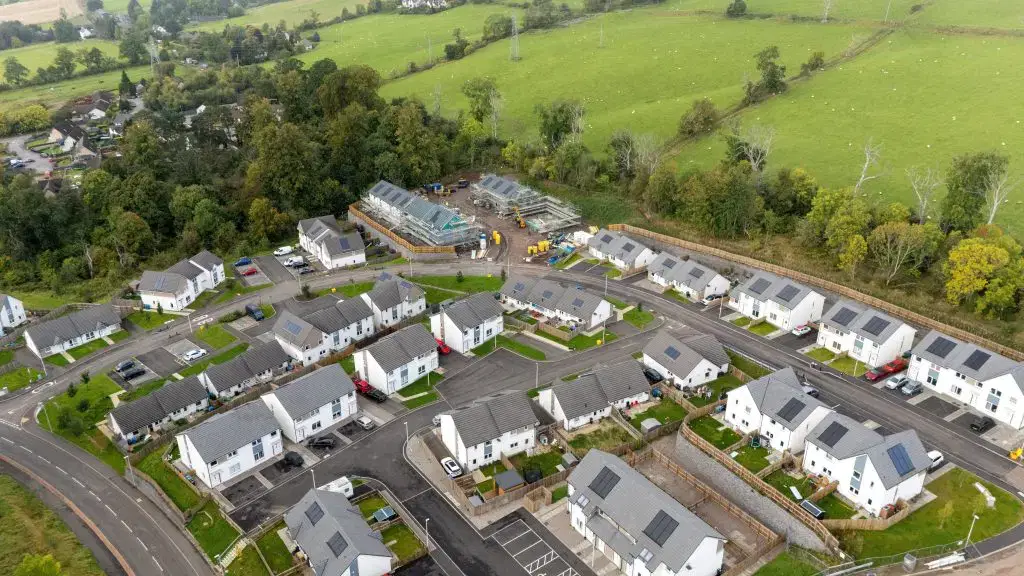
A recently published briefing from the Scottish Parliament Information Centre (SPICe) on Scotland’s Affordable Housing Supply Programme provides a timely assessment of progress towards the Scottish Government’s target of delivering 110,000 affordable homes by 2032.
The figures highlight the scale of the challenge.
By the end of March 2026, 35,368 affordable homes had been completed towards the target, around 32% of the total. With just over five years remaining, approximately 77,500 homes are still required. That means delivering more than 15,000 affordable homes every year, while recent annual averages have been around 7,000 approvals and 7,300 site starts.
The SPICe briefing also sets these figures against a challenging delivery environment, including construction cost inflation, labour shortages, supply-chain pressures, borrowing costs and previous reductions in capital funding.
For me, the report reinforces a fundamental point.
Scotland doesn’t have a housing ambition problem. It has a delivery problem.
The question now is how we turn targets, funding and policy commitments into a sustained pipeline of homes on the ground.
Funding certainty is an important step.
The Scottish Government’s commitment to invest at least £4.1 billion over four years in the Affordable Housing Supply Programme is significant. The 2026/27 AHSP budget stands at £926 million, a 14% real-terms increase on the previous year.
Perhaps as important as the headline figure is the move towards greater funding certainty.
Housing development is a long-term activity. Sites have to be identified, assembled and assessed. Infrastructure needs to be understood. Designs need to be developed, planning permissions secured, funding assembled and contractors appointed before construction can begin.
Trying to plan that process against short-term or uncertain funding inevitably makes efficient delivery more difficult.
But increased funding on its own won’t deliver the homes Scotland needs.
The SPICe briefing highlights historical underspends within the programme, including £166 million in 2021/22, £103 million in 2022/23 and £59 million in 2023/24.
That shouldn’t simply be interpreted as money that wasn’t needed. It points towards a wider issue of deliverability.
We need a pipeline, not simply a target.
If Scotland is going to substantially increase housing output, we need to think beyond individual projects and create a much stronger pipeline of deliverable development.
That means having sites where housing need, land, funding, planning, infrastructure, design and procurement are sufficiently aligned to allow projects to progress.
There are significant barriers.
As the SPICe briefing identifies, construction cost inflation, labour shortages, supply-chain pressures and higher borrowing costs are all affecting delivery. Housing associations and councils are also balancing investment in new homes against substantial commitments to their existing stock.
These aren’t problems that any single organisation can solve.
Government, local authorities, housing associations, developers, consultants, contractors, funders and the wider supply chain all have a role.
The question we should increasingly be asking is:
What is preventing this project from becoming a home, and how do we remove that obstacle earlier?
That requires earlier collaboration and greater visibility of future programmes. It also means considering affordability, buildability, energy performance and procurement from the outset rather than trying to resolve those issues once a project is already well advanced.
Could More Homes Scotland help close the gap?
The proposed More Homes Scotland agency could be an important part of that change.
The SPICe briefing explains that the Scottish Government intends the agency to become fully operational in 2028/29. Its proposed functions include greater use of land assembly and preparation powers, enhanced support for planning and development delivery, greater opportunities for standardisation, simplified commissioning and more flexible approaches to funding.
Those are encouraging objectives because they address several of the practical barriers that can slow housing development.
But the test for the new organisation should ultimately be straightforward:
Does it make good housing easier and quicker to deliver?
The housing sector doesn’t need additional complexity or another layer of process. What it needs is greater coordination, faster decision-making and an ability to unlock sites and projects that are currently stalled by viability, infrastructure, planning, procurement or funding constraints.
There is also an opportunity to look again at how we commission and design housing.
Standardisation and simplified commissioning don’t have to mean standard places. Used intelligently, repeatable design principles, coordinated technical standards and greater continuity of workload can improve efficiency while still allowing architects and masterplanners to respond properly to context, community and place.
For an industry being asked to deliver substantially more homes, finding that balance between efficiency, quality and place will become increasingly important.
From targets to delivery
The SPICe briefing provides a useful reminder of the scale of the task ahead.
Scotland clearly needs ambitious housing targets. They demonstrate the scale of need and provide direction for government and industry.
But targets don’t build homes.
At current levels of approvals and starts, the briefing makes clear that achieving the 110,000 target will require a significant scaling-up of delivery.
The challenge now is to turn increased investment and political commitment into a deliverable programme.
That means maintaining long-term funding certainty, creating a much stronger pipeline of viable projects, addressing barriers earlier and making the development process simpler rather than more complicated.
If More Homes Scotland can help achieve that, it should be welcomed.
The numbers in the SPICe briefing tell us that maintaining the current rate of delivery will not be enough. The next phase of Scotland’s response to the housing emergency therefore needs to be less about announcing how many homes we want to build and much more about creating the conditions that allow everyone involved to get on and build them.
David Keith
Senior Partner, Bracewell
Architecture | Masterplanning | Energy